Thursday, September 16, 2021

Should Physicians Recommend Vitamins, Minerals and Micronutrients To Patients With Cancer?: An Analysis From The Perspective of ESPEN Guideline

Should Physicians Recommend Vitamins, Minerals and Micronutrients To Patients With Cancer?: An Analysis From The Perspective of ESPEN Guideline

Dr. Mehmet Eren Yuksel

Ankara Yıldırım Beyazıt University School of Medicine, Intensive Care Unit, Ankara, Turkey. e-mail: doctormehmeteren@yahoo.com

Dr. Hasan Dirik

Ankara City Hospital, Intensive Care Unit, Ankara, Turkey. e-mail: hsndrk_38@hotmail.com

Abstract

Background: The number of cancer patients using complementary and alternative medicine (CAM) is rapidly increasing in Turkey. However, it is a matter of debate if physicians should prescribe vitamins, minerals and micronutrients to patients with cancer.

Method: A Pubmed search, between the years 1990 and 2021, was performed to identify the prevalence of patients using CAM. Moreover, studies about vitamin C-D-E supplementation were examined according to the recommendations of European Society for Clinical Nutrition and Metabolism (ESPEN) guideline (1).

Results: Ernst et al. published the first systemic review regarding the prevalence of CAM use in cancer patients, which was 31.4%, in 1998 (2). Horneber et. al  reported in 2012 that their meta-analysis included 152 studies from 18 countries with 65.000 cancer patients and the prevalance of CAM usage was 40% (3). The CAM use was the highest in the United States (50%) and the lowest both in Italy and the Netherlands (22%). Turkey had the highest prevalence of CAM use with 48% in Europe (3). ESPEN guideline on clinical nutrition in cancer published in 2021 pointed out a few studies (1). Wang et al. reported that a total of 14,641 male physicians received 400 IU of vitamin E and 500 mg of vitamin C daily for 10 years. However, vitamin E and C supplementation had no immediate or long-term effects on the risk of total cancer and prostate cancer (4). Bolland et al. stated that vitamin D supplementation did not reduce skeletal or non-skeletal outcomes in individuals by more than 15% (5). Klein et al. revealed that dietary supplementation with vitamin E significantly increased the risk of prostate cancer (6).

Conclusion: Despite the fact that approximately 50% of all cancer patients consume CAM, ESPEN recommends that vitamins and minerals should be supplied in amounts equal to the recommended daily allowance, whereas high-dose micronutrients should be discouraged in the absence of specific deficiencies (1).

Keywords: Alternative, cancer, complementary, medicine, vitamin

References:

1. Muscaritoli M, Arends J, Bachmann P, Baracos V, Barthelemy N, Bertz H, et al. ESPEN practical guideline: Clinical Nutrition in cancer. Clin Nutr. 2021;40(5):2898-913.

2. Ernst E, Cassileth BR. The prevalence of complementary/alternative medicine in cancer: a systematic review. Cancer. 1998;83(4):777-82.

3. Horneber M, Bueschel G, Dennert G, Less D, Ritter E, Zwahlen M. How many cancer patients use complementary and alternative medicine: a systematic review and metaanalysis. Integr Cancer Ther. 2012;11(3):187-203.

4. Wang L, Sesso HD, Glynn RJ, Christen WG, Bubes V, Manson JE, et al. Vitamin E and C supplementation and risk of cancer in men: posttrial follow-up in the Physicians' Health Study II randomized trial. Am J Clin Nutr. 2014;100(3):915-23.

5. Bolland MJ, Grey A, Gamble GD, Reid IR. The effect of vitamin D supplementation on skeletal, vascular, or cancer outcomes: a trial sequential meta-analysis. Lancet Diabetes Endocrinol. 2014;2(4):307-20.

6. Klein EA, Thompson IM, Jr., Tangen CM, Crowley JJ, Lucia MS, Goodman PJ, et al. Vitamin E and the risk of prostate cancer: the Selenium and Vitamin E Cancer Prevention Trial (SELECT). Jama. 2011;306(14):1549-56.

Conference: 2. International Cancer Days, Sivas Cumhuriyet University, 16-18 September 2021

https://kansergunleri.cumhuriyet.edu.tr/?page_id=589&lang=tr


Tuesday, July 20, 2021

Anadolu Ajansı, Covid-19, Bayram

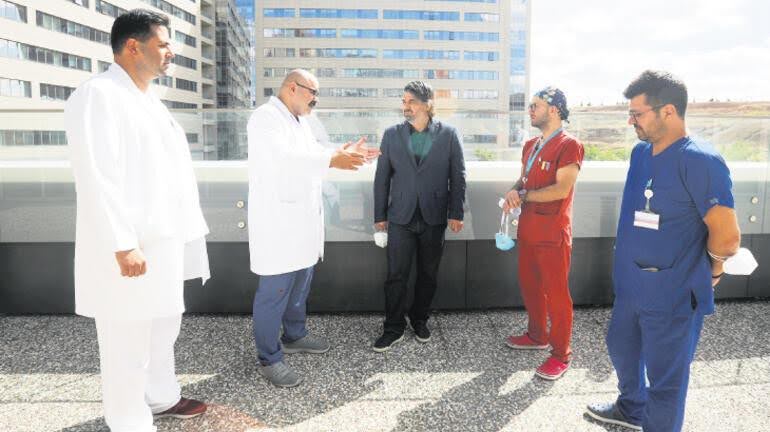
Ankara Şehir Hastanesinde, Kovid-19 hastalarının tedavi gördüğü yoğun bakım servisinde görev yapan doktor ve hemşireler, birçok meslektaşı gibi bu yıl da Kurban Bayramı'nı sevdiklerinden uzakta, şifa vermek için çabaladıkları hastalarının yanı başında geçiriyor.

Yoğun bakım servisindeki zorlu nöbetleri esnasında, AA ekibinin görüntülediği sağlık çalışanları, en büyük umutlarının aşılamayla toplumsal bağışıklığa erişilmesi ve salgının son bulması olduğunu vurguladı.

Ankara Şehir Hastanesi Kovid-19 yoğun bakım servisinde görev yapan Doktor Mehmet Eren Yüksel, "Bayramda Kovid-19 geçiren hastalarımızı tedavi etmek için var gücümüzle çalışmaya devam edeceğiz. Bayramda tatil yapmıyoruz, hastalarımızın yanında olacağız. Eğer hastalarımız iyileşirse bizim için en büyük bayram olacak." dedi.

Doktor Yüksel, toplumsal bağışıklığın sağlanmasıyla insanların da sevdiklerine doya doya sarılabileceğine işaret ederek, "Herkesin içi rahat olsun. Türkiye Cumhuriyeti güçlü, devletimizin bize sağladığı imkanlar sayesinde hastalarımıza en iyi şekilde bakıyoruz." açıklamasında bulundu.

Haber:

Kovid-19 nöbetindeki sağlık çalışanlarının buruk ama umutlu bayramı @anadoluajansi

http://v.aa.com.tr/2309828

https://www.aa.com.tr/tr/gundem/kovid-19-nobetindeki-saglik-calisanlarinin-buruk-ama-umutlu-bayrami/2309828


Wednesday, May 19, 2021

BK viremia exacerbation with COVID-19 infection in a kidney transplant recipient

CP-007
BK VIREMIA EXACERBATION WITH COVID-19 INFECTION IN A KIDNEY
TRANSPLANT RECIPIENT
Şerife Bektaş1, Mehmet Eren Yuksel1, Çağlayan Merve Ayaz2, Seval İzdeş1
1Ankara Yildirim Beyazit University School of Medicine, Intensive Care Unit
2Ankara City Hospital, Department of Infectious Diseases
INTRODUCTION: Immunocompromised patients with Coronavirus-19 disease (COVID-19) who have previously undergone kidney transplantation should be carefully examined for BK virus, which is a DNA virus from polyoma-virus family and is localized in renal tubular epithelial cells after primary infection.
CASE: A 61-year-old male patient complaining of chest pain was admitted to the emergency department. High serum troponin level and COVID-19 PCR positivity were detected. Since non-ST-MI could not be ruled out, the patient was admitted to the intensive care unit for further follow-up and treatment. The thorax-CT revealed ground-glass appearance with peripherally localized patchy interlobular septal thickening in both lungs. The patient admitted that he underwent bilateral nephrectomy for renal cell carcinoma and renal transplantation in 2013, having been treated with oral mycophenolate mofetil 180 mg 2x1, everolimus 0.75 mg 2x1, prednisolone 5 mg 1x1. His serum creatinine level in January 2021 was 1.97 mg/dL (reference range: 0.7-1.3 mg/dL), whereas his serum creatinine level rose up to 4.73 mg/dl and the glomerular filtration rate decreased to 15% in April 2021. Urine BK virus PCR examination (Artus QS-RG Q Real-Time PCR) revealed 93.206 copies/mL (linear range in plasma and urine: 50-9.26x10.000.000 copies/ml, analytical sensitivity: 26.7 copies/ml). Moreover, blood BK virus PCR revealed 70 copies/mL.
CONCLUSION: 80% of the general population is infected with BK virus. However, activation of the BK virus may cause interstitial nephritis and failure of the allograft in immunosuppressive patients who have had a kidney transplant. Reactivation of BK virus is associated with a weaker cytotoxic CD8+ T cell response in immunocompromised patients. T cells, especially CD8+ T cells, are also decreased in COVID-19 patients. Therefore, BK virus infection should be suspected in renal transplant patients infected with COVID-19 when serum creatinine level gradually increases.
Keywords : BK virus, COVID-19, Renal, Transplantation
May 2021
  • Conference: 23rd International Intensive Care E-Symposium , Turkish Society of Intensive Care


Sunday, March 07, 2021

News

 http://www.xinhuanet.com/english/2018-10/05/c_137513392_6.htm

http://www.xinhuanet.com/english/2018-10/05/c_137513392_4.htm


Chinese Ambassador to Turkey Yu Hongyang (R) asks a doctor for information about injured Chinese tourists in Aksaray, Turkey, on Oct. 5, 2018.

Covid-19 cases in Turkey


A medical worker checks the test results of a COVID-19 patient at a hospital in Ankara, Turkey, on Jan. 8, 2021. Turkey reported on Friday 11,479 COVID-19 cases, including 1,291 symptomatic patients, as the total number of positive cases in the country reached 2,307,581, its health ministry announced. (Xinhua)