Tuesday, July 20, 2021

Anadolu Ajansı, Covid-19, Bayram

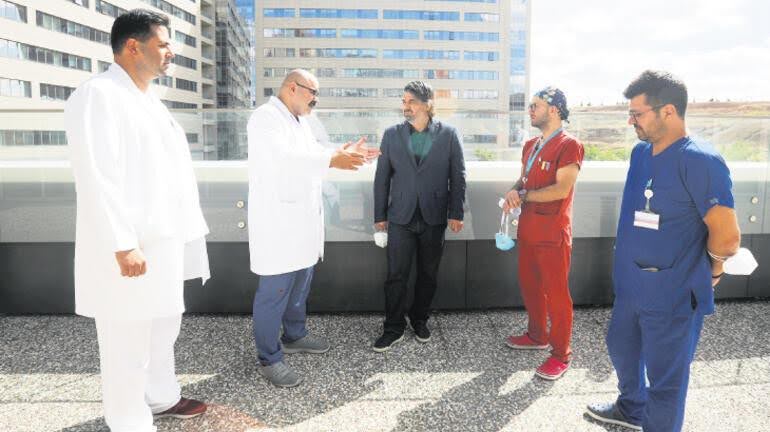
Ankara Şehir Hastanesinde, Kovid-19 hastalarının tedavi gördüğü yoğun bakım servisinde görev yapan doktor ve hemşireler, birçok meslektaşı gibi bu yıl da Kurban Bayramı'nı sevdiklerinden uzakta, şifa vermek için çabaladıkları hastalarının yanı başında geçiriyor.

Yoğun bakım servisindeki zorlu nöbetleri esnasında, AA ekibinin görüntülediği sağlık çalışanları, en büyük umutlarının aşılamayla toplumsal bağışıklığa erişilmesi ve salgının son bulması olduğunu vurguladı.

Ankara Şehir Hastanesi Kovid-19 yoğun bakım servisinde görev yapan Doktor Mehmet Eren Yüksel, "Bayramda Kovid-19 geçiren hastalarımızı tedavi etmek için var gücümüzle çalışmaya devam edeceğiz. Bayramda tatil yapmıyoruz, hastalarımızın yanında olacağız. Eğer hastalarımız iyileşirse bizim için en büyük bayram olacak." dedi.

Doktor Yüksel, toplumsal bağışıklığın sağlanmasıyla insanların da sevdiklerine doya doya sarılabileceğine işaret ederek, "Herkesin içi rahat olsun. Türkiye Cumhuriyeti güçlü, devletimizin bize sağladığı imkanlar sayesinde hastalarımıza en iyi şekilde bakıyoruz." açıklamasında bulundu.

Haber:

Kovid-19 nöbetindeki sağlık çalışanlarının buruk ama umutlu bayramı @anadoluajansi

http://v.aa.com.tr/2309828

https://www.aa.com.tr/tr/gundem/kovid-19-nobetindeki-saglik-calisanlarinin-buruk-ama-umutlu-bayrami/2309828


Wednesday, May 19, 2021

BK viremia exacerbation with COVID-19 infection in a kidney transplant recipient

CP-007
BK VIREMIA EXACERBATION WITH COVID-19 INFECTION IN A KIDNEY
TRANSPLANT RECIPIENT
Şerife Bektaş1, Mehmet Eren Yuksel1, Çağlayan Merve Ayaz2, Seval İzdeş1
1Ankara Yildirim Beyazit University School of Medicine, Intensive Care Unit
2Ankara City Hospital, Department of Infectious Diseases
INTRODUCTION: Immunocompromised patients with Coronavirus-19 disease (COVID-19) who have previously undergone kidney transplantation should be carefully examined for BK virus, which is a DNA virus from polyoma-virus family and is localized in renal tubular epithelial cells after primary infection.
CASE: A 61-year-old male patient complaining of chest pain was admitted to the emergency department. High serum troponin level and COVID-19 PCR positivity were detected. Since non-ST-MI could not be ruled out, the patient was admitted to the intensive care unit for further follow-up and treatment. The thorax-CT revealed ground-glass appearance with peripherally localized patchy interlobular septal thickening in both lungs. The patient admitted that he underwent bilateral nephrectomy for renal cell carcinoma and renal transplantation in 2013, having been treated with oral mycophenolate mofetil 180 mg 2x1, everolimus 0.75 mg 2x1, prednisolone 5 mg 1x1. His serum creatinine level in January 2021 was 1.97 mg/dL (reference range: 0.7-1.3 mg/dL), whereas his serum creatinine level rose up to 4.73 mg/dl and the glomerular filtration rate decreased to 15% in April 2021. Urine BK virus PCR examination (Artus QS-RG Q Real-Time PCR) revealed 93.206 copies/mL (linear range in plasma and urine: 50-9.26x10.000.000 copies/ml, analytical sensitivity: 26.7 copies/ml). Moreover, blood BK virus PCR revealed 70 copies/mL.
CONCLUSION: 80% of the general population is infected with BK virus. However, activation of the BK virus may cause interstitial nephritis and failure of the allograft in immunosuppressive patients who have had a kidney transplant. Reactivation of BK virus is associated with a weaker cytotoxic CD8+ T cell response in immunocompromised patients. T cells, especially CD8+ T cells, are also decreased in COVID-19 patients. Therefore, BK virus infection should be suspected in renal transplant patients infected with COVID-19 when serum creatinine level gradually increases.
Keywords : BK virus, COVID-19, Renal, Transplantation
May 2021
  • Conference: 23rd International Intensive Care E-Symposium , Turkish Society of Intensive Care


Sunday, March 07, 2021

News

 http://www.xinhuanet.com/english/2018-10/05/c_137513392_6.htm

http://www.xinhuanet.com/english/2018-10/05/c_137513392_4.htm


Chinese Ambassador to Turkey Yu Hongyang (R) asks a doctor for information about injured Chinese tourists in Aksaray, Turkey, on Oct. 5, 2018.

Covid-19 cases in Turkey


A medical worker checks the test results of a COVID-19 patient at a hospital in Ankara, Turkey, on Jan. 8, 2021. Turkey reported on Friday 11,479 COVID-19 cases, including 1,291 symptomatic patients, as the total number of positive cases in the country reached 2,307,581, its health ministry announced. (Xinhua)

Tuesday, September 15, 2020

Deep Learning for Medicine and Remote Sensing: A Brief Review

In recent years, deep learning methods have come to the forefront in many areas that require remote sensing, from medicine to agriculture, from defense industry to space research; and these methods have given more successful results as compared to traditional methods. The major difference between deep learning and classical recognition methods is that deep learning methods consider an end-to-end learning scheme which gives rise to learning features from raw data. In this study, we discuss the remote sensing problems and how deep learning can be used to solve these problems with a special focus on medical and defense applications. In particular, we review architectures within the deep learning literature and their use cases.

Applications in Defense and Security, Applications in Medicine, Deep Learning

https://dergipark.org.tr/tr/pub/ijegeo/issue/56780/710913


Sunday, September 06, 2020

Saturday, September 05, 2020

Do we really need to wear coveralls in the modern intensive care unit during the fight with Covid-19?

The Eurasian Journal of Medicine

https://www.eajm.org/en/do-we-really-need-to-wear-coveralls-in-the-modern-intensive-care-unit-during-the-fight-with-covid-19-133308

Yuksel ME, Izdes S, Surel AA, Guner R. Do We Really Need to Wear Coveralls in the Modern Intensive Care Unit during the Fight with Covid-19? Eurasian J Med 2020; DOI 10.5152/eurasianjmed.2020.20195


A rare case of secondary syphilis presenting with extensive cutaneous nodules and generalised lymphadenopathy

Acıbadem Üniversitesi Sağlık Bilimleri Dergisi  

http://acibadem.dergisi.org/

https://dergipark.org.tr/en/pub/acusaglik/issue/58146/831359

Syphilis is an infectious disease caused by the spirochete Treponema pallidum. Syphilis is divided into clinical stages including primary, secondary, latent and tertiary syphilis. Secondary syphilis can present with various mucocutaneous lesions and multisystem involvement. Since it can mimic many other diseases, syphilis is known as ‘the great imitator'. However, secondary syphilis with nodular lesions is very rare. Moreover, nodular secondary syphilis can be misdiagnosed as syphilitic nodules of the tertiary stage. Hereby, we report an unusual presentation of secondary syphilis characterized by extensive erythematous nodules and generalised lymphadenopathy in an immunocompetent 39-year-old Caucasian male patient.